What Do You Give Grandparents Who Already Have Everything?
A five-question framework for choosing a meaningful gift that creates connection, preserves a story, improves a routine, or avoids unnecessary clutter.

8 min read
When grandparents say they already have everything, they are usually not asking you to search harder for a more unusual object. They may be telling you that storage is limited, their routines are settled, or the part of family life they value most cannot be wrapped.
A good answer is to stop asking, “What can I buy?” and start asking, “What can this gift help us do, remember, replace, enjoy, or schedule?” That shift turns a frustrating shopping problem into a much smaller set of useful choices.
For a ready-made shortlist, see our Grandparents Day gifts for grandparents who say they need nothing. The framework below explains how to make the decision yourself-even when your grandparents insist there is nothing left to buy.
The short answer
Give something that strengthens connection, preserves a family story, improves an existing routine, gets used up, or puts real time together on the calendar. The best choice is rarely the most expensive one. It is the one with the clearest reason to exist in their life.
Use this five-question gift test
These five questions work for birthdays, Christmas, Grandparents Day, and ordinary family visits. Answer them in order. You may discover that the right gift is a replacement, a shared plan, or a small act of preparation rather than a new category of possession.
1. What do they already use every week?
Look for evidence in the home and in conversation: the blanket always on one chair, the radio in the kitchen, the same tea every evening, the worn garden gloves, the library books beside the bed, or the paper calendar covered in family dates. A better version of something already used is usually safer than a clever object that creates a new habit.
- Replace: Upgrade a worn everyday item rather than adding a duplicate.
- Refill: Restock a favorite consumable in a gift-worthy way.
- Support: Add a small tool that makes an existing hobby easier.
- Prepare: Set up a device, subscription, or activity before it reaches them.
2. Would connection be more valuable than another object?
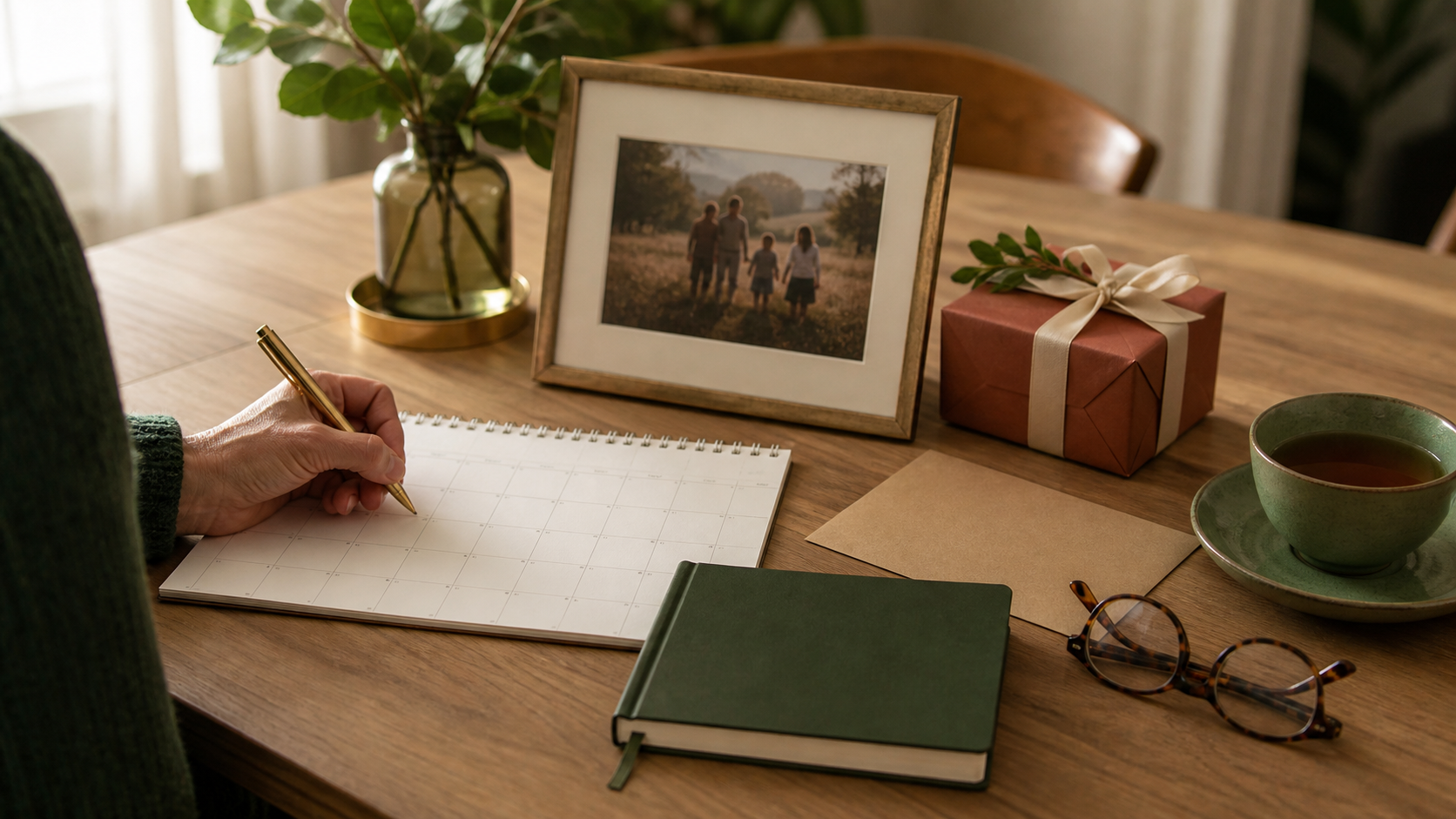
A gift can make family contact easier without turning affection into a technology project. A preloaded photo frame, a recurring phone date, a question game for the next visit, or a calendar with family plans already written in can all create more opportunities to interact. Research on experiential gifts suggests that shared or anticipated experiences can strengthen relationships more than material gifts alone.
The important word is specific. “We should have lunch sometime” is not yet a gift. A reservation, selected date, transportation plan, or printed schedule turns a good intention into something that can actually happen.
3. Is there a story, recipe, photograph, or voice worth preserving?
Many meaningful grandparent gifts are not about nostalgia for its own sake. They give family knowledge a usable form: a guided life-story journal, labeled photographs, a recorded conversation, a recipe book begun with familiar dishes, or a framed image chosen for the story behind it.
Do not hand over an empty project and call it meaningful. Add the first photographs, write the first question, schedule the first interview, or copy the first recipe. Your preparation lowers the effort required and shows that the project matters to you too.
4. Can the gift disappear through use?
Consumable gifts are useful when you know the recipient’s actual preferences. Tea, coffee, pantry treats, stationery, puzzle books, birdseed, garden supplies, or a planned meal can feel generous without leaving a permanent storage problem.
Consumable does not automatically mean safe. Check dietary needs, caffeine preferences, fragrance sensitivity, household rules, and whether the gift creates maintenance. The goal is to remove clutter, not replace it with obligation.
5. What work will this gift create?
Every gift has a hidden workload: setup, charging, cleaning, returning, storing, renewing, learning, or disposing. For someone who says they need nothing, that workload may matter more than the feature list.
- Who will connect it to Wi-Fi, create the account, and adjust the settings?
- Where will it live when it is not being used?
- Does it require refills, replacement parts, paid renewal, or regular cleaning?
- Can the recipient return or exchange it without difficulty?
- Will the giver remain available when a question comes up later?
| What you notice | A stronger gift direction | What to avoid |
|---|---|---|
| They ask for more family photos | A preloaded frame, printed album, or one framed photograph | An empty device they must configure |
| They tell the same family stories | A guided journal or scheduled recorded conversation | A blank scrapbook with no help starting |
| They use the same worn item every day | A carefully matched replacement | A novelty version that changes the routine |
| They value visits more than packages | A dated outing, meal, or recurring call | A vague promise to get together later |
| Their home already feels full | A consumable, digital library, shared activity, or service | Decorative signs and oversized keepsakes |
| They enjoy one established hobby | A modest upgrade, refill, or comfort tool | A kit for an entirely new hobby |
How to ask without ruining the surprise
You do not need to ask, “What gift do you want?” Ask about the routine around the gift instead. The answers reveal constraints while leaving room for a surprise.
- “Is there anything around the house you keep meaning to replace?”
- “What do you use most when you are reading, cooking, gardening, or watching TV?”
- “Would you rather have one family photo displayed or a frame that changes?”
- “Is there a family story or recipe you wish the younger generation knew?”
- “Would an outing be fun, or would you prefer something we can do at home?”
- “Are there foods, fragrances, fabrics, or subscriptions you would rather avoid?”
Should you give one shared gift or two separate gifts?
A shared gift makes sense when both grandparents genuinely use the same thing: a photo frame in a common room, a family game, a meal, an outing, or a calendar of visits. Separate gifts are better when their hobbies, comfort preferences, technology habits, dietary needs, or daily routines are different.
Do not force symmetry. One grandparent may love a guided journal while the other would rather receive binoculars, a favorite snack, or an afternoon together. Equal attention matters more than identical boxes.
What works for long-distance grandparents?
Choose a gift that supports a repeatable connection after delivery. Good examples include a preloaded photo display that family members continue updating, a set of letters with future mailing dates, a shared book or puzzle, a recurring call attached to a familiar weekly routine, or a journal whose answers become the topic of later conversations.
The ongoing plan is the important part. A connected device that no one updates soon becomes furniture; a keepsake journal that no one asks about becomes homework. Decide who will participate and what happens next.
Be especially careful with health, mobility, and aging-related gifts
Do not turn a celebration into an unsolicited assessment. Magnifiers, pill organizers, mobility tools, large-display devices, hearing products, and safety equipment can be genuinely useful, but they should respond to a stated need or a conversation-not an assumption based on age.
When the need is real, involve the recipient in the decision. Fit, compatibility, comfort, medical advice, and personal dignity matter more than preserving the surprise.
How much should you spend?
There is no required amount. A printed photograph, planned lunch, recorded interview, favorite treat, or replacement for a worn everyday item can be more successful than an expensive gadget. Spend more only when the purchase matches a known routine and you can include the setup, return option, or ongoing support it needs.
The price of the gift cannot substitute for evidence that you paid attention.
FaveSift editorial principle
What not to give grandparents who already have everything
- Generic plaques, slogan decor, and “Best Grandma” or “Best Grandpa” objects chosen only for the label
- Large appliances, furniture, or connected devices without discussing space and setup
- A subscription with unclear renewal terms or no cancellation plan
- Clothing, footwear, or health products when fit and preference are guesses
- A personalized item that cannot be returned when style is uncertain
- A hobby starter kit for an interest they have never expressed
- A complicated keepsake project that transfers all the work to them
- A promise of time together without a date, transportation plan, or follow-through
How We Developed This Framework
This is an editorial decision guide rather than a hands-on product test. We combined the official intergenerational purpose of National Grandparents Day with research on experiential gifts and practical guidance on social connection in later life. The resulting framework prioritizes attention, recipient fit, manageable effort, and repeatable family connection.
Frequently Asked Questions
What is the best gift for grandparents who say they want nothing?
Choose something that creates connection, preserves a family story, replaces an item they already use, gets consumed, or puts specific time together on the calendar.
Is money or a gift card appropriate for grandparents?
It can be when it matches a real preference, restaurant, hobby, or planned outing. A short note explaining the intended experience makes it feel more considered.
What is a meaningful gift that does not create clutter?
Consider a planned experience, a consumable, one consolidated photo display, a digital reading library, a recorded family story, or a replacement for something worn out.
Are personalized gifts always more meaningful?
No. Personalization works when it reflects a real story, photograph, recipe, or routine. A name printed on an unrelated object does not automatically make it thoughtful.
Should grandchildren make the gift themselves?
Child participation can make a gift meaningful, but an adult should help create a finished, usable result and handle ordering, safety, setup, or preservation where needed.
What can I give grandparents who live far away?
Choose something that supports recurring contact, such as a preloaded photo frame, scheduled calls, mailed letters, a shared book, a story journal, or a family activity you can discuss remotely.
How do I avoid making an age-related gift feel insulting?
Respond to a need the recipient has named, involve them when fit or compatibility matters, and describe the gift around the activity it supports rather than assumptions about aging.
When is Grandparents Day in 2026?
National Grandparents Day is Sunday, September 13, 2026, in the United States.
Sources and Updates
This framework was reviewed on August 10, 2026. It is intended to support thoughtful gift decisions, not to prescribe one type of relationship, household, ability, or family tradition.
- National Grandparents Day Council u2014 purpose and 2026 observance
- Journal of Consumer Research u2014 Experiential Gifts Foster Stronger Social Relationships Than Material Gifts
- National Institute on Aging u2014 Loneliness and Social Isolation
- August 10, 2026Initial editorial framework completed and aligned with the 2026 Grandparents Day cluster.
About the author
Maya Carter
Maya covers everyday tech and thoughtful gift ideas for FaveSift. Before joining the editorial team, she helped independent retailers turn dense product details into useful, human buying guides. Her work focuses on the features that change an ordinary commute, workday, or weekend listen.